Views: 0 Author: Site Editor Publish Time: 2025-09-02 Origin: Site


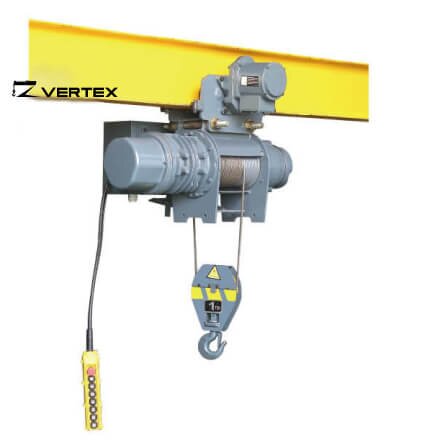
The single-beam wire rope hoist is a light and small lifting equipment. Its core features are simple structure and easy operation. Its main function is to realize the vertical lifting and short-distance horizontal transportation of heavy objects.
Features
Simple structure and low cost: The whole crane is composed of core components such as motor, reducer, drum, wire rope, etc. It is easy to install and maintain. Compared with double-beam or complex lifting equipment, the purchase and use costs are lower.
High lifting efficiency and strong adaptability: Wire rope transmission has a strong carrying capacity, can cover different tonnages (usually ranging from 0.5 tons to 20 tons), and can be flexibly deployed in various scenarios such as indoor workshops, warehouses, and small docks.
Easy to operate and safe: standard ground button box control, some can be equipped with wireless remote control, intuitive operation; most are equipped with upper limit switch, overload protection and other devices to reduce lifting risks.
High space utilization: usually used in conjunction with a single-girder crane, it occupies a small space and is particularly suitable for places with limited factory height and compact working space.
Effect
Core role: It can realize vertical lifting (lifting) of heavy objects and horizontal movement along the single-beam track, completing operations such as loading, unloading, transshipment and stacking of goods.
Application scenarios: It is widely used in machinery manufacturing, warehousing and logistics, food processing, building materials and other industries, such as the installation and commissioning of machine tools in the workshop, the loading and unloading of goods in the warehouse, and the transportation of raw materials next to the production line.
Value: It replaces manual handling, greatly reduces labor intensity, improves work efficiency, and ensures stability and safety during heavy object handling.
Characteristics and functions of Japanese single-beam wire rope hoist:
Features
High Safety: Utilizing a high-strength DC disc brake, the crane achieves up to twice the standard torque, enabling rapid, active braking. The wire rope drum is constructed from high-quality steel, featuring a deep groove design and a rope guide for precise rope routing. Three high-strength metal locks secure the wire rope, leaving three reels of excess at the top even when the hook is in the lowered position. Upper and lower rotary vane circuit limiters and an overload protection device are standard.
Strong overweight capacity: The wire rope is made of multiple strands of fine steel wires, has high tensile strength, can lift heavier objects, and is suitable for large-scale lifting operations.
Smooth operation: The oil-immersed gear transmission mechanism adopts a three-stage speed reduction design. The precision-machined gear set runs in a leak-proof cast aluminum gearbox, with smooth transmission and low noise.
Flexible Operation: The dual-speed hoist motor has a high-to-low speed ratio of 4:1, meeting the requirements of accurate low-speed positioning and rapid high-speed takeoff and landing. The trolley is equipped with a standard rotating hook that can rotate freely within a range of 360 degrees horizontally and 180 degrees vertically, facilitating loading and unloading.
Low headroom design: can shorten the distance between the machine body and the beam track, suitable for lower buildings or places where the effective lifting space needs to be expanded.
Effect
It is mainly used for various lifting, pulling, loading and unloading operations of heavy objects. It can be used in conjunction with single-girder and double-girder cranes, jib cranes, gantries, etc. in workshops, warehouses, wind power generation, logistics, docks, construction and other places to achieve vertical lifting and horizontal movement of heavy objects, facilitating the lifting, loading and unloading of goods, as well as the installation, commissioning and maintenance of equipment.
The key to selecting a suitable single-girder wire rope hoist is to match actual operational requirements with safety standards. The following key dimensions should be considered:
Clarify core load requirements (most critical)
Rated lifting capacity: Determined based on the maximum weight of the objects lifted daily, with an additional 10%-20% safety margin reserved (for example, if you often lift 5 tons of cargo, a 5-6.3 ton hoist is preferred to avoid overloading).
Lifting height: Measure the distance from the ground to the bottom of the beam at the work site to ensure that the hoist's lifting height can meet the highest lifting position of the goods (including the height of the hook itself).
2. Matching operating and installation conditions
Running speed: Select according to production efficiency requirements. For light loads and frequent operations, you can choose a high speed (such as 8-10m/min), for heavy loads and precise positioning, you can choose a low speed (2-5m/min). Some hoists support "fast and slow speed switching".
Installation method: Single-beam hoists are commonly installed with "I-beam track type". It is necessary to confirm that the track model (such as 16#, 20# I-beam) matches the hoist running wheel to avoid operation jams caused by track mismatch.
3. Focus on security and protection configuration
Safety is the bottom line, and the following basic protections must be ensured:
Overload protection device: Automatically cuts off power when the rated weight is exceeded to prevent the hoist from being damaged or the cargo from falling.
Limit switch: Automatically stops when lifting/lowering reaches the limit position to avoid wire rope breaking or hook hitting the top.
Braking system: It can be locked immediately after power failure to prevent heavy objects from slipping (electromagnetic braking is preferred for faster response).
4. Comprehensive use environment screening
Conventional indoor: select the standard type (carbon steel material, ordinary motor).
Humid/dusty environment: You need to choose a hoist with waterproof (IP54 and above), dust-proof motor, or galvanized surface.
Inflammable and explosive environments: Explosion-proof type must be selected (complying with GB3836 standards, motors and electrical components are all explosion-proof).
Considering the above core key dimensions, choose the appropriate single-girder wire rope hoist according to your own use environment and conditions, so that you can get twice the result with half the effort.